
Coolant Treatment Systems
Clean coolants for stable production processes
Safe and Clean Transport of Chips and Other Materials
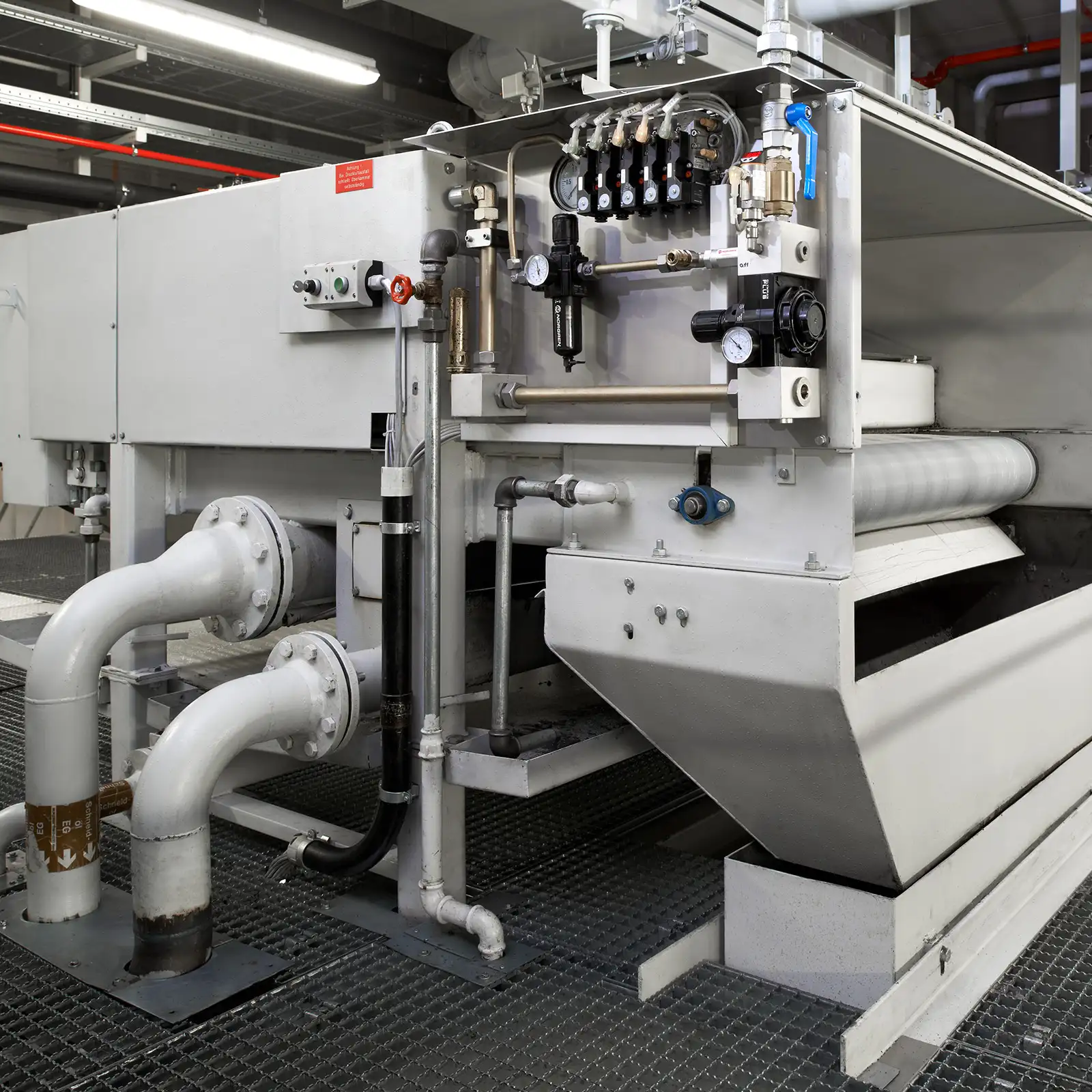
During metalworking, coolants become contaminated with chips, wear debris and tramp oil. This can shorten coolant service life and increase the risk of tolerance deviations and machine faults. KÖBO ECO>PROCESS develops coolant treatment systems that, depending on their configuration, separate coarse to very fine particles, remove tramp oil and return the cleaned fluid to the production process. This can reduce coolant consumption as well as the effort required for tool changes and disposal.
Details
Without effective coolant treatment, costs and downtime can increase
In metalworking, coolants become contaminated with chips, wear debris, sludge and tramp oil. Without a coolant treatment system tailored to the process, pumps and nozzles can be exposed to increased contamination, tool life can be reduced and workpiece quality can be affected.
Temperature fluctuations can also influence the properties of the coolant and consequently affect process stability. A coolant treatment system removes contaminants, returns the cleaned coolant to the circuit and can, if required, be supplemented with coolant temperature control. This supports consistent fluid quality and stable production conditions.
APPLICATION
How coolant treatment systems work and which components they use
A coolant treatment system cleans the coolant in clearly defined stages. If required, coolant temperature control can also be integrated into the system. Each stage performs a dedicated function to keep the fluid circulating within the production process.
➔
Pre-separation: Chip separators remove coarse chips and other solid particles.
➔
Filtration: Depending on the requirements, belt filters or precoat filters remove chips, wear debris and sludge from the coolant down to the micrometre range.
➔
Oil separation: Separators remove tramp oil and help extend coolant service life.
➔
Recirculation: Pumps return the cleaned and, if required, temperature-controlled fluid to the machine.
➔
Monitoring: Sensors measure flow rate, fluid levels, temperatures, pressures and their development over time. This data can be used to determine the level of contamination.
➔
Discharge: Residues are transported automatically via conveying systems into collection containers for disposal.
Pumps, sensors and control components are configured for the respective production process. They monitor parameters such as flow rate, fluid level, pressure and temperature and control the filtration process as well as the required cleaning and discharge cycles. Depending on the filtration method, differential-pressure monitoring, backflushing or a separate regeneration tank can be used.
Request a coolant treatment systemSpecifications
Our coolant treatment systems
KÖBO ECO>PROCESS develops coolant treatment systems ranging from individual filtration units to fully automatic central systems. Depending on the application, different coolant filtration and separation systems are combined. Each system is engineered for the coolant, particle load, flow rate and required filtration rating. Its modular design allows it to be integrated into new or existing production lines.
Pressure belt filter
Function
The pressure belt filter is a fully automatic filtration system for coolants. Contaminated coolant is pumped into the upper pressure chamber and forced under pressure through a continuous or reversible filter belt or filter fleece. The cleaned coolant flows back into a clean-fluid tank. Before discharge, the retained filter cake is blown dry and then removed automatically.
Details
- Fully automatic operation for high solids loads
- Filter cake is dried before discharge
Vacuum belt filter
Function
A suction chamber beneath the filter belt draws the coolant through the filter medium under vacuum. The solids remain on the filter belt and are discharged intermittently. During the discharge and cleaning cycle, a separate regeneration tank maintains the coolant supply to the connected machines.
Details
- Continuous operation without interruption
- Central collection tank for the coolant circuit
Folding belt filter
Function
The folding belt filter is a compact variant of the pressure belt filter. It is particularly suitable for lower flow rates and for use as a secondary filter in precoat filter systems. The coolant is passed intermittently under pressure through a filter belt or filter fleece. The cleaned coolant flows into a downstream tank, while the filter cake is dried before automatic discharge.
Details
- Compact design for restricted installation spaces
- Suitable for lower flow rates and secondary filtration
Precoat filter
Function
A filter aid such as cellulose, diatomaceous earth or perlite forms a fine filter layer on a support medium. This layer retains particles down to the single-digit micrometre range. Once the filter layer is saturated, the system is regenerated automatically and a new precoat is applied before the filtration process continues.
Details
- High filtration quality down to below 10 µm
- Suitable for honing, grinding and hard-machining processes using oil or aqueous solutions
Chip separator
Function
The chip separator removes coarse chips during the first treatment stage. Depending on the configuration, separation takes place by sedimentation, across a slotted screen or, for ferromagnetic chips, using a magnetic system.
This reduces the solids load on downstream filtration systems.
Details
- Automatic discharge of separated chips
- Available with sedimentation, a slotted screen or a magnetic system, depending on the configuration
- Reduces the load on downstream filtration systems
Benefits of our coolant treatment systems
Clean process fluid
Coolant treatment systems remove chips, wear debris and other contaminants from the coolant. This reduces the load on pumps and supports a stable production process.
Longer tool life
Clean coolant reduces the contaminant load on tools and can extend their service life. Fewer tool changes help reduce downtime and ongoing operating costs.
Consistent component quality
Consistent coolant quality supports stable machining conditions and reduces the risk of dimensional deviations and surface defects.
Lower consumption and disposal requirements
Treatment and recirculation allow the coolant to remain in the production circuit for longer. Depending on the process, this can reduce the demand for fresh fluid as well as the effort required for fluid changes and disposal.
Automated system operation
Automatic monitoring, cleaning and discharge cycles reduce the need for manual intervention and support a reliable supply of coolant to the connected machines.
Modular system design
Coolant treatment systems are configured modularly to suit the required flow rate, particle load, filtration rating and installation conditions. Depending on the system configuration, flow rates from 200 to 30,000 L/min are possible. Individual filtration and separation stages can be combined or operated in parallel.
process
How we work with you
➔
Consultation: We discuss your requirements and develop an initial system concept.
➔
Quotation: Once the relevant technical details have been clarified, you receive a customised quotation.
➔
Engineering: Working closely with you, we design a system tailored to your process and installation environment. All drawings are produced in 3D CAD.
➔
Project execution: Our team manages implementation and ensures the system is delivered turnkey and on schedule.
➔
After-sales service: Following commissioning, we continue to support you with spare parts, maintenance and repair services.
Details
How coolant treatment systems can reduce operating costs
The cost-effectiveness of a coolant treatment system depends on factors such as flow rate, particle load, tooling costs, fluid changes and disposal requirements. Longer coolant service life, fewer tool changes and reduced maintenance requirements can lower ongoing operating costs. KÖBO ECO>PROCESS configures each system for the respective production process and evaluates potential cost savings on a project-specific basis.
Contact
Are you planning a new coolant treatment system or looking to modernise your existing equipment? Speak directly with our team. We develop a concept tailored to your production process and designed to support consistent operating conditions.
Request a consultationFAQ